
How to Search Erie County Property Records
Erie County offices link every parcel through the SBL, owner fields, deed references, the assessment roll, the tax account, and map geometry. Start your property search with whatever clue you hold. Then follow it across systems. Always check the source date and the municipality before trusting any single result.
- Erie County offices connect each parcel through the SBL, owner fields, recorded deed references, assessment roll, tax account, and map geometry. Read the source date and municipal context before relying on a result.
- Erie County offices connect each parcel through the SBL, owner fields, recorded deed references, assessment roll, tax account, and map geometry. Read the source date and municipal context before relying on a result.
- Erie County offices connect each parcel through the SBL, owner fields, recorded deed references, assessment roll, tax account, and map geometry. Read the source date and municipal context before relying on a result.
- Erie County offices connect each parcel through the SBL, owner fields, recorded deed references, assessment roll, tax account, and map geometry. Read the source date and municipal context before relying on a result.
- Erie County offices connect each parcel through the SBL, owner fields, recorded deed references, assessment roll, tax account, and map geometry. Read the source date and municipal context before relying on a result.
Erie County Property Records Offices
No single Erie County office holds everything. The Clerk records deeds. Assessors build the rolls. County tax services maintain shared parcel and map data. A property search works best when you know which door to knock on.
Erie County Recorder / Register of Deeds
92 Franklin Street
Erie County offices connect each parcel through the SBL, owner fields, recorded deed references, assessment roll, tax account, and map geometry. Read the source date and municipal context before relying on a result., NY 14202
716-858-8785
Erie County Assessor / Appraisal District
92 Franklin Street
Erie County offices connect each parcel through the SBL, owner fields, recorded deed references, assessment roll, tax account, and map geometry. Read the source date and municipal context before relying on a result., NY 14202
716-858-8785
Erie County Treasurer / Tax Collector
92 Franklin Street
Erie County offices connect each parcel through the SBL, owner fields, recorded deed references, assessment roll, tax account, and map geometry. Read the source date and municipal context before relying on a result., NY 14202
716-858-8785
Types of Erie County Property Records
Erie County property records come in distinct types. A deed fixes ownership. The assessment roll sets value. Tax records show what is owed. Plats and GIS maps define boundaries. The parcel number ties them together.
| Record Type | What It Documents | Kept By | Access |
|---|---|---|---|
| Deeds | Erie County offices connect each parcel through the SBL, owner fields, recorded deed references, assessment roll, tax account, and map geometry. Read the source date and municipal context before relying on a result. | Erie County Clerk | Erie County offices connect each parcel through the SBL, owner fields, recorded deed references, assessment roll, tax account, and map geometry. Read the source date and municipal context before relying on a result. |
| Mortgages & liens | Erie County offices connect each parcel through the SBL, owner fields, recorded deed references, assessment roll, tax account, and map geometry. Read the source date and municipal context before relying on a result. | Erie County Clerk | Erie County offices connect each parcel through the SBL, owner fields, recorded deed references, assessment roll, tax account, and map geometry. Read the source date and municipal context before relying on a result. |
| Tax & assessment | Erie County offices connect each parcel through the SBL, owner fields, recorded deed references, assessment roll, tax account, and map geometry. Read the source date and municipal context before relying on a result. | Municipal assessor and tax collector | Erie County offices connect each parcel through the SBL, owner fields, recorded deed references, assessment roll, tax account, and map geometry. Read the source date and municipal context before relying on a result. |
| Plats & parcels | Erie County offices connect each parcel through the SBL, owner fields, recorded deed references, assessment roll, tax account, and map geometry. Read the source date and municipal context before relying on a result. | Erie County GIS and Tax Mapping | Erie County offices connect each parcel through the SBL, owner fields, recorded deed references, assessment roll, tax account, and map geometry. Read the source date and municipal context before relying on a result. |
| Building permits | Erie County offices connect each parcel through the SBL, owner fields, recorded deed references, assessment roll, tax account, and map geometry. Read the source date and municipal context before relying on a result. | Erie County offices connect each parcel through the SBL, owner fields, recorded deed references, assessment roll, tax account, and map geometry. Read the source date and municipal context before relying on a result. | Erie County offices connect each parcel through the SBL, owner fields, recorded deed references, assessment roll, tax account, and map geometry. Read the source date and municipal context before relying on a result. |
Each record type answers a different question. The deed names the owner of record. The assessor's appraisal explains the taxable value. The tax roll lists the levy. Map geometry shows the parcel itself.
What Erie County Property Records Can and Cannot Tell You
Erie County property records can answer many questions but not all of them. Deeds and rolls show ownership, value, and taxes. They cannot prove title is clean or settle private disputes. Match each record to its municipality and year.
Lawful use. Erie County offices connect each parcel through the SBL, owner fields, recorded deed references, assessment roll, tax account, and map geometry. Read the source date and municipal context before relying on a result.
Erie County Deed Index Coverage
The Erie County Clerk Official Records Search is the recorded-document side of an Erie County property records search. Its standard land-record index starts January 1, 1986. The Clerk reports deed images reaching back to January 1, 1960. The deeds themselves date to 1808. That gap matters. An older transfer may exist even when a modern name search fails to surface it. A practical method: find the newest owner. Note the deed book and page. Then work backward through each grantor. Browser View serves users who cannot use the main interface. Public terminals at the Clerk's office offer another route.
The Clerk records far more than deeds. Mortgages, assignments, satisfactions, judgments, liens, lis pendens, powers of attorney, and business filings can all illuminate a parcel's history. An index hit is only a pointer, though. Read the image or get a copy. Do that before concluding anything about title, a debt, or whether an earlier filing was released.
Erie County Assessment Calendar
Assessment work in Erie County is local. Buffalo, Lackawanna, Tonawanda, and every town and village act as their own assessing units. County Real Property Tax Services maintains the shared parcel, tax-map, and tax information. The town calendar typically runs this way. March 1 is the taxable-status and exemption date. A tentative roll appears May 1. Grievance day follows in May. The final roll lands July 1. City schedules can differ. Always read a roll with its year and municipality in mind. Ownership, exemptions, and values may shift after the copy you are viewing.
The official Erie County assessment calendar lists these milestones.
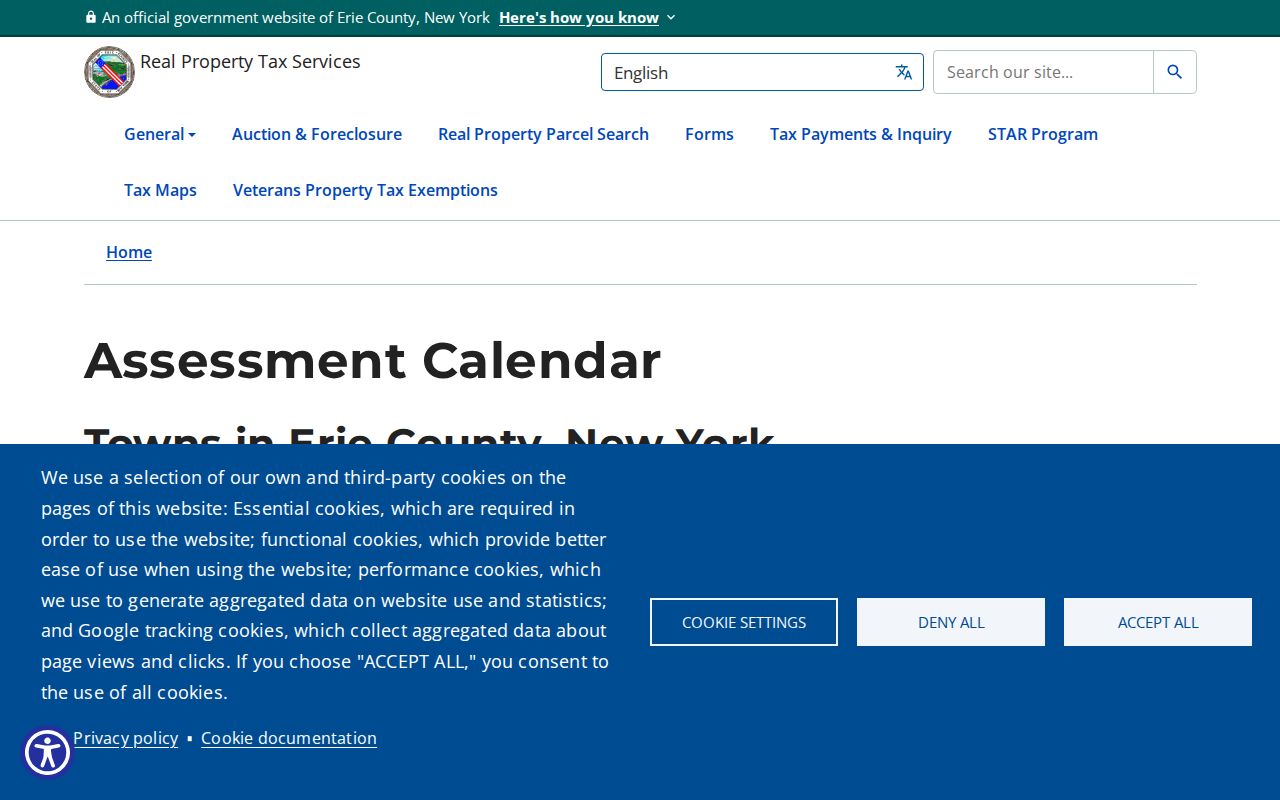
The official assessment calendar places a value or exemption in its correct roll cycle before you compare it with a deed or tax bill.
Erie County Property Alert
The Clerk's free Property Alert watches the index for you. It does not block recording. Register a party name or an SBL. The service sends notice when a matching document enters the record. The Clerk cautions that verification can take five to seven business days. Matching may also miss spelling variants or filings that lack the enrolled text. Even so, it remains a useful second line of awareness. It covers a home, a rental, a commercial site, or a vacant parcel.
The official Property Alert page explains enrollment and matching.
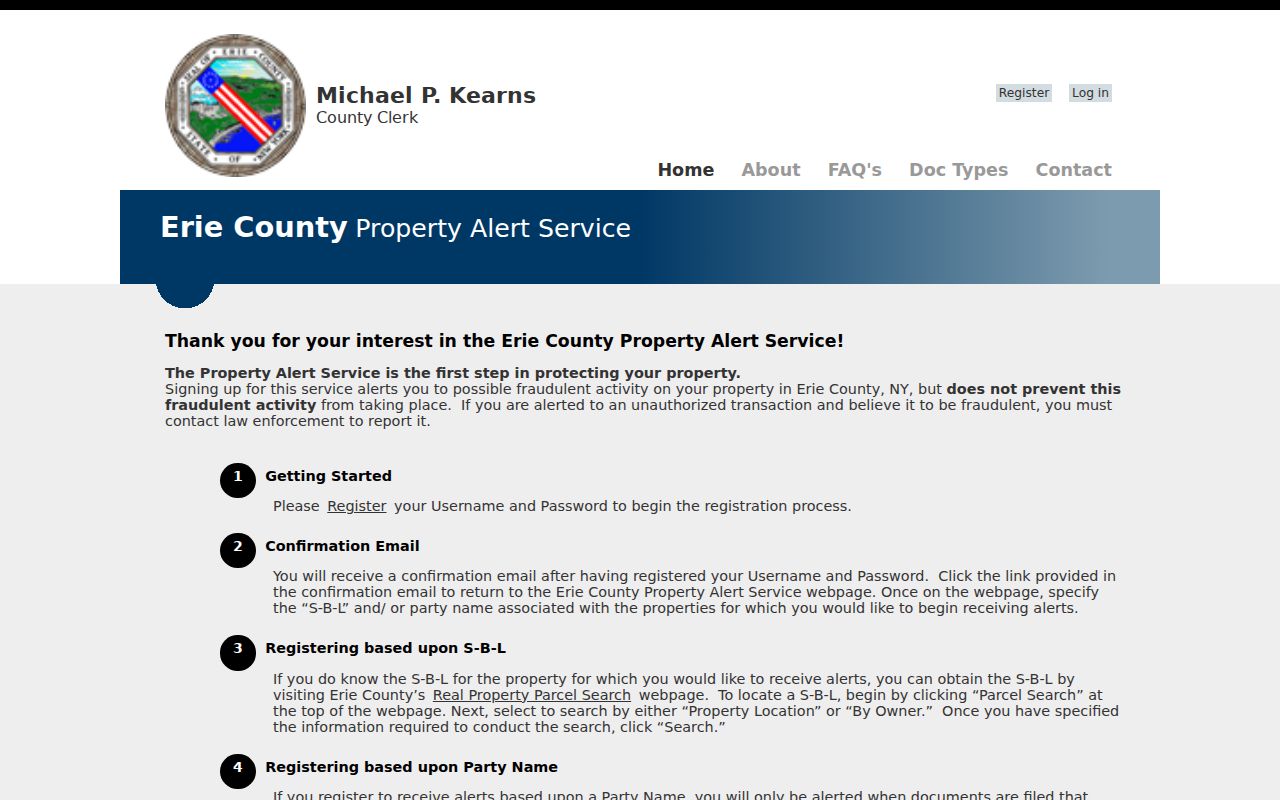
Copy the SBL straight from the parcel record, add the relevant owner-name forms, and take any notice directly to the Clerk for investigation.